
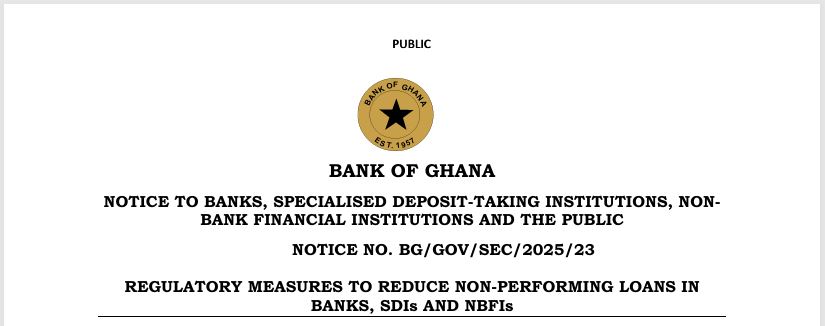
Non-Performing Loans (NPLs) are loans that borrowers fail to repay. When too many of these pile up, banks lose money, struggle to lend, and the whole financial system becomes shaky. To protect Ghana’s banking sector, the Bank of Ghana (BOG) has rolled out new rules that every bank, microfinance company, and non-banking financial institution must follow.
Here’s the big picture, explained simply:
1. Stronger Credit Risk Management
Banks must tighten how they give out loans. This means:
- Clear rules for who qualifies for a loan.
- Enough trained staff to check loan applications properly.
- Systems to track whether borrowers are paying on time.
- Early warning systems to spot loans that might go bad.
- Regular reporting of loan data to credit bureaus.
Think of it as banks being more careful before lending and keeping a close eye afterwards.
2. Setting Limits on Bad Loans
By December 2026, banks must keep their NPLs below 10% of total loans (microfinance institutions have a stricter 5% limit).
- If they go above this, they must submit a recovery plan within 30 days.
- From January 2027, banks that fail to comply will face restrictions: no dividends, no bonuses, and no risky loan growth.
In short, banks can’t reward themselves if they’re not managing bad loans properly.
3. Writing Off Hopeless Loans
If a loan is clearly unrecoverable, banks must write it off (remove it from their books) — but only with BOG’s approval.
- This doesn’t mean the borrower gets away free; banks must still chase repayment or sell the debt.
- Loans linked to directors or major shareholders are treated very seriously. If they default, they can lose their positions or be forced to sell their shares.
4. Restructuring Loans for Struggling Borrowers
Banks can renegotiate loan terms to make repayment easier — for example, lowering interest, extending repayment time, or allowing smaller installments.
- But the loan will still count as “non‑performing” until the borrower proves stability by making several consecutive repayments.
5. Acting Fast on Collateral
If a loan is written off, banks must move quickly (within 30 days) to recover collateral, like property or assets pledged against the loan. If they delay, BOG will step in with penalties.
6. Naming and Shaming Wilful Defaulters
A “wilful defaulter” is someone who can pay but refuses, or who misuses loan money, lies about collateral, or disappears without notice.
- Banks must publish lists of such defaulters twice a year in newspapers and on their websites.
- These defaulters will be banned from taking new loans for years, depending on how long they take to settle their debts.
- Company directors and guarantors who knowingly help in fraud will also be blacklisted.
7. Transparency and Reporting
Banks with NPLs above 7% must send monthly reports to the BOG.
Annual reports must also show:
- How much was written off?
- Sector breakdowns of bad loans.
- Names of related parties with unpaid loans.
- Recovery details from both wilful and non‑wilful defaulters.
In simple terms
The Bank of Ghana is cautioning banks to lend wisely, clean up bad debts promptly, and refrain from rewarding themselves if they’re not managing risks properly. Borrowers, on the other hand, must take repayment seriously — because the era of easy defaults is over.
infographic‑style summary
🏦 Bank of Ghana’s New Rules on Bad Loans (NPLs)
📌 What’s Changing?
- Stricter loan checks → Banks must carefully screen borrowers and monitor repayments.
- Limits on bad loans → By Dec 2026, NPLs must stay below 10% (5% for microfinance).
- No rewards for poor management → From Jan 2027, banks above the limit lose dividends & bonuses.
🔄 Handling Problem Loans
- Write off hopeless loans → With BOG approval, but still chase repayment.
- Restructure loans → Easier repayment terms, but still “non‑performing” until proven stable.
- Recover collateral fast → Banks must act within 30 days or face penalties.
🚫 Naming & Shaming
Wilful defaulters (those who can pay but refuse) will be:
- Published in newspapers & online twice a year.
- Banned from new loans for years.
- Directors/guarantors involved in fraud are also blacklisted.
📊 Transparency & Reporting
- Banks with NPLs above 7% → Monthly reports to BOG.
- Annual reports must show:
- Loan write‑offs.
- Sector breakdowns.
- Names of related parties in default.
- Recovery details.
✅ Bottom line
Banks must lend wisely, clean up bad debts quickly, and borrowers must take repayment seriously. The era of easy defaults is over.
REFERENCE
Bank of Ghana, “Regulatory Measures to Reduce Non‑Performing Loans in Banks, SDIs and NBFIs,” Notice No. BG/GOV/SEC/2025/23, issued 13th August 2025
