
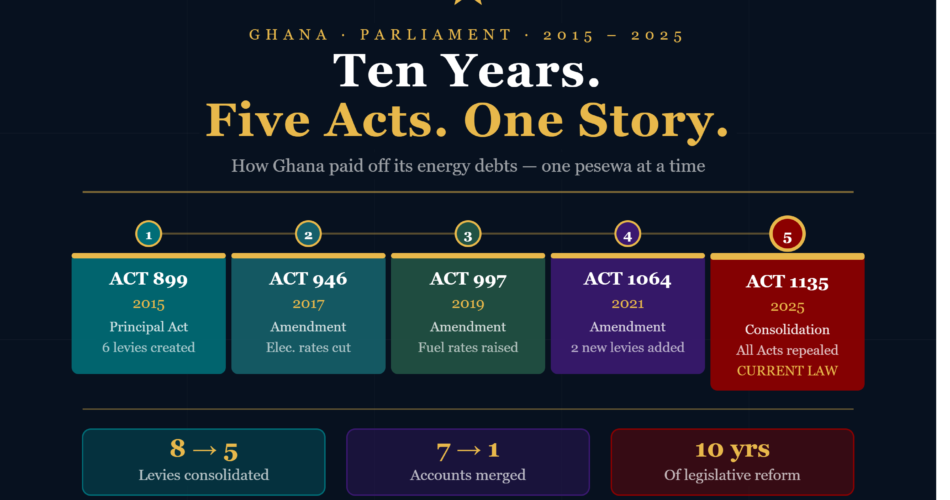
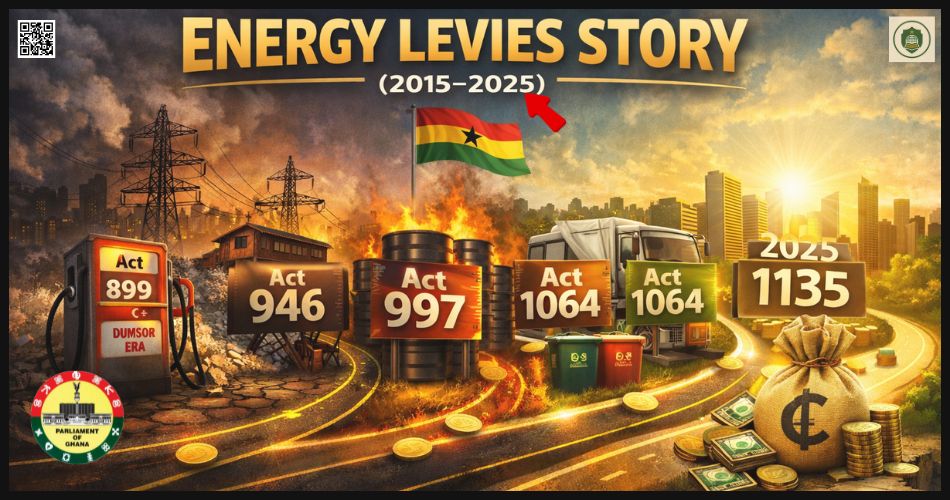
Every time you filled your tank or flicked a switch, you were paying off debts buried deep in Ghana’s energy sector. Few noticed. Fewer understood. But Parliament was quietly rewriting the rules. Here Is the Full Story Nobody Told You.
Prologue – The Invisible Tax You Pay Every Day
You pull into a filling station in Accra. You top up twenty litres of petrol. You drive home. You plug in your phone, turn on your fan, maybe boil water for tea.
You just paid several laws at once — and you probably did not know it.
Buried inside every litre of fuel you buy, and every kilowatt-hour of electricity you consume, is a collection of charges that Ghana’s Parliament has been carefully building, adjusting, expanding and — most recently — consolidating over the last ten years. These are the Energy Sector Levies: legal instruments designed to fix one of the most persistent, painful problems Ghana has faced since independence — the fact that the energy sector perpetually spends more than it collects, and someone has to pay that difference.
The Chaos Before the Law — Why Act 899 Had to Be Born
Cast your mind back to 2015.
Ghana was in the middle of what many still call the worst energy crisis in the country’s modern history. “Dumsor” — the Twi-English shorthand for the rotating power outages that plunged homes and businesses into darkness for up to twelve hours a day — had become the defining feature of daily life. Factories were running on generators. Businesses were closing. People were losing money every single day.
But the crisis was not just about power cuts. Beneath the surface, the energy sector was drowning in debt.
The Tema Oil Refinery (TOR) — Ghana’s only petroleum refinery, located in Tema — had accumulated staggering debts it could not repay. Every time the cedi weakened against the dollar (which was often), the petroleum companies importing fuel faced what accountants call “foreign exchange under-recoveries” — meaning the local currency they collected from consumers was simply not enough to pay for the foreign currency they needed to import crude oil—the difference — billions of cedis — piled up as debt.
At the same time, multiple laws existed that attempted to address these problems, but they were scattered, disconnected and often contradictory. There was a Debt Recovery (Tema Oil Refinery) Fund Act from 2003. There was an Electricity (Special Levies) Act from 1995. There were regulations from 2012. Each had its own rules, its own rates, its own collecting agencies and its own accounts. Nobody — not the ordinary Ghanaian, not even most government officials — could tell you with confidence exactly what charges existed, who was collecting them, or where the money was going.
Parliament looked at this landscape and decided: enough is enough. We need one law. One framework. One clear set of rules.
On 24th December 2015, President John Dramani Mahama signed Act 899 — the Energy Sector Levies Act, 2015 into law. It was gazetted six days later, on 30th December 2015.
ACT 899 (2015): THE FOUNDATION — BRINGING ORDER TO THE ENERGY CHAOS
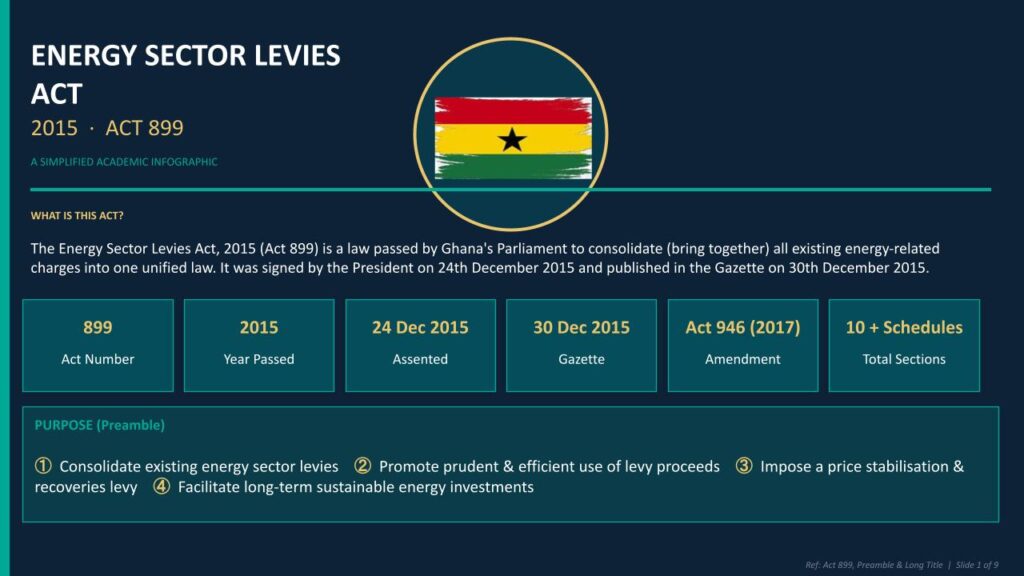
Act 899 was not a small piece of legislation. It was a consolidation — a bringing-together — of everything that had come before, packaged into one clean, logical law with ten sections, two Schedules and a clear purpose.
What Act 899 actually created:
Parliament imposed six levies — six distinct charges that would be collected every time Ghanaians bought fuel or consumed electricity:
- The Energy Debt Recovery Levy — charged at GHp41 per litre on petrol and diesel. This was the big one. It was specifically designed to pay back TOR’s debts, cover the foreign exchange losses in the petroleum sector, and fund power generation and infrastructure. Think of it as Ghana’s national energy debt repayment charge, built into every litre of fuel.
- The Road Fund Levy — GHp40 per litre on petrol and diesel. Straightforward: the money goes to fixing and maintaining Ghana’s roads. Every pothole repaired, every highway resurfaced — this levy contributes.
- The Energy Fund Levy — GHp1 per litre on petrol, kerosene, diesel and fuel oil. A small charge to fund the operations of the Energy Commission of Ghana — the body that regulates the energy sector.
- The Price Stabilisation and Recovery Levy — GHp12 per litre on petrol, GHp10 on diesel and GHp10 per kilogramme on LPG (cooking gas). This was Ghana’s price shock absorber. When global oil prices spike, this fund absorbs the blow so that pump prices do not jump overnight and leave ordinary Ghanaians unable to afford fuel or to cook.
- The Public Lighting Levy — 5% of the price of every kilowatt-hour of electricity consumed. This goes toward the traffic lights you drive through, the street lights that illuminate your neighbourhood at night, and the public lighting maintained by your Municipal or District Assembly.
- The National Electrification Scheme Levy — also 5% of every kilowatt-hour. Ghana’s electrification programme — the one that has been extending the national grid to rural communities across the country — needs money to run. This levy provided it.
Where the money went — the three accounts:
Act 899 also created three dedicated accounts to hold and disburse these funds properly:
- The Energy Debt Service Account — a holding account for TOR debt repayment and petroleum forex losses
- The Power Generation and Infrastructure Support Sub-Account — fed by portions of the Energy Debt Recovery Levy and electricity levies, used to pay power utility debts and keep the electricity grid stable
- The Price Stabilisation and Recovery Account — the “buffer fund” for petroleum price shocks, also used to subsidise premix fuel for fishermen and residual fuel oil for industry
The collecting agencies were clear: the Ghana Revenue Authority (GRA) collected the fuel levies; the electricity distribution companies — Electricity Company of Ghana (ECG), the Northern Electricity Distribution Company (NEDCO) and other suppliers — collected the electricity levies; and the National Petroleum Authority (NPA) collected the Price Stabilisation levy.
The accountability mechanism: the Minister for Finance was required to submit an annual report to Parliament on how all these accounts were being managed.
Act 899 also did something important on its way in: it swept away the old laws. The Electricity (Special Levies) Act of 1995 was completely repealed. Large chunks of the Debt Recovery (Tema Oil Refinery Company) Fund Act of 2003 were amended. The old petroleum pricing regulations were updated. The house was cleaned. For the first time, Ghana had one clear energy levies law. One framework. One set of rules.
Two Years Later — The 2017 Adjustment
By 2017, the data was in, and something was becoming clear: the electricity levy rates set in 2015 — both at 5% per kilowatt-hour — were putting a heavy burden on electricity consumers. Ghana’s electricity tariffs were already among the highest in the region relative to average incomes. Adding 10% in levies on top (5% for Public Lighting plus 5% for the National Electrification Scheme) was making electricity unaffordable for many households and businesses.
At the same time, Parliament was looking at how the money was being routed. Under Act 899, significant portions of the electricity levy proceeds were being funnelled into the Power Generation and Infrastructure Support Sub-Account — a sub-account that was primarily meant to be funded by petroleum levies. There was a view that this routing was unnecessarily complicated and that the electricity levies should flow more directly to their intended purposes.
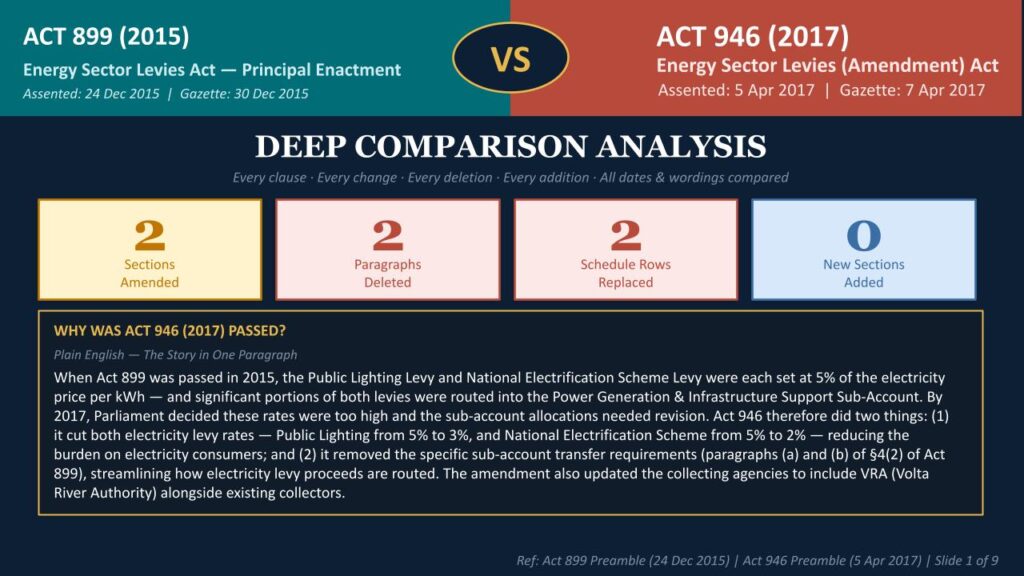
On 5th April 2017, the President assented to Act 946 — the Energy Sector Levies (Amendment) Act, 2017. It was gazetted just two days later on 7th April 2017.
Act 946 was brief — just two sections — but its impact was significant:
What changed:
First, it cut the Public Lighting Levy rate from 5% to 3% per kilowatt-hour. For every GHS100 electricity bill, the Public Lighting component dropped from GHS5 to GHS3. A 40% reduction.
Second, it cut the National Electrification Scheme Levy from 5% to 2% per kilowatt-hour — a 60% reduction. For every GHS100 electricity bill, this component fell from GHS5 to just GHS2. This was the biggest percentage cut of any single levy rate in this entire legislative series.
Third, it removed the obligation to route portions of these electricity levies into the Power Generation and Infrastructure Support Sub-Account. The sub-account would now only receive its 68% of the Energy Debt Recovery Levy from petroleum. Electricity levies would go directly to their intended destinations — the Ministry responsible for Power and the Electricity Distribution Companies.
Fourth — and this is a detail many missed — it formally added VRA (the Volta River Authority) as a named collecting agency alongside ECG and NEDCO. VRA, Ghana’s largest power generator and distributor, had somehow been left off the original list in 2015. That was now corrected.
One small but notable word change: the Public Lighting Levy’s purpose clause was narrowed — the specific mention of replacing street lights destroyed by hit-and-run motor vehicles was quietly removed. (This would come back in 2025.)
In plain language: The 2017 amendment was a relief measure for electricity consumers. Parliament recognised that the electricity levy burden was too high, cut it significantly and simplified the money-routing rules. Electricity bills became slightly lower as a result.
Back to Fuel — The 2019 Rate Increases
Two years of relief for electricity consumers. But now a different pressure was building.
The Power Generation and Infrastructure Support Sub-Account — stripped of its electricity levy income by the 2017 amendment — was feeling the strain. Power utility companies were piling up debts. Road infrastructure needed more money. And the Price Stabilisation reserve was running thin, making Ghana vulnerable to global oil price spikes.
Parliament’s answer, on 19th August 2019, was Act 997 — the Energy Sector Levies (Amendment) Act, 2019. Notably, it was assented to and gazetted on the same day — a sign of urgency.
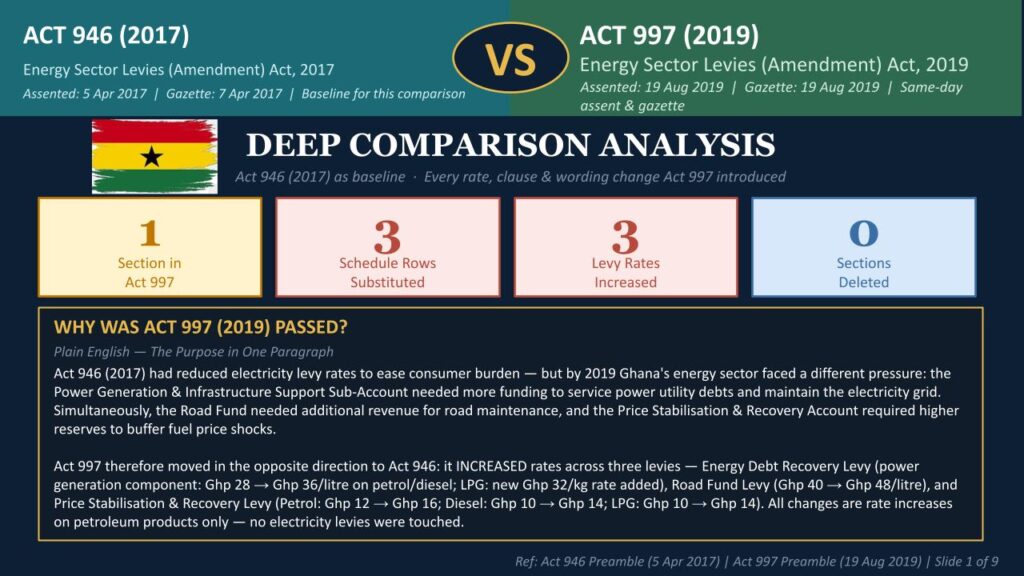
Act 997 did not touch electricity levies at all. It went straight for the petroleum charges and raised three of them:
What changed:
The Energy Debt Recovery Levy on petrol and diesel rose from GHp41 to GHp49 per litre — a GHp8 increase driven entirely by raising the power generation and infrastructure support component from GHp28 to GHp36 per litre. The forex and TOR debt components stayed the same. For LPG users, the total rose from GHp37 to GHp41 per kilogramme, with the power support component going from GHp28 to GHp32 per kilogramme. Importantly, Act 997 also formally set out the breakdown of the LPG levy for the first time, making it clearer where each pesewa was going.
The Road Fund Levy rose from GHp40 to GHp48 per litre on petrol and diesel — a clean 20% increase. Ghana’s roads needed the money, and Parliament provided it. Even the formatting was tidied: the old “GHp40.0” (with its redundant decimal) became simply “GHp48.”
The Price Stabilisation and Recovery Levy saw the biggest percentage increases of the three. Petrol went from GHp12 to GHp16 per litre (a 33% increase). Diesel and LPG both went from GHp10 to GHp14 per litre/kilogramme (a 40% increase each). The buffer fund needed replenishing.
In plain language: While 2017 gave electricity users a break, 2019 asked fuel users to pay more. The logic was consistent — the energy sector’s financial needs had to be met somewhere. With electricity levies reduced, petroleum levies had to carry more of the load. Every time you filled up your tank after August 2019, you were contributing more to Ghana’s power infrastructure and road maintenance than you were before.
A New Crisis Demands New Tools — The 2021 Expansion
Then came 2020. A global pandemic. Economic disruption. Supply chain shocks. Energy sector companies — already burdened with debts — found themselves in an even more precarious position. Power stations were owed money. Capacity charges — the fees paid to power generators even when their plants are not running — were going unpaid. Ghana’s energy sector legacy debts, accumulated over decades of underpayment and mismanagement, were threatening the stability of the entire electricity supply.
Something fundamentally new was needed. Not a tweak to existing rates. Something structural.
On 31st March 2021, the President assented to Act 1064 — the Energy Sector Levies (Amendment) Act, 2021. It was also gazetted the same day.
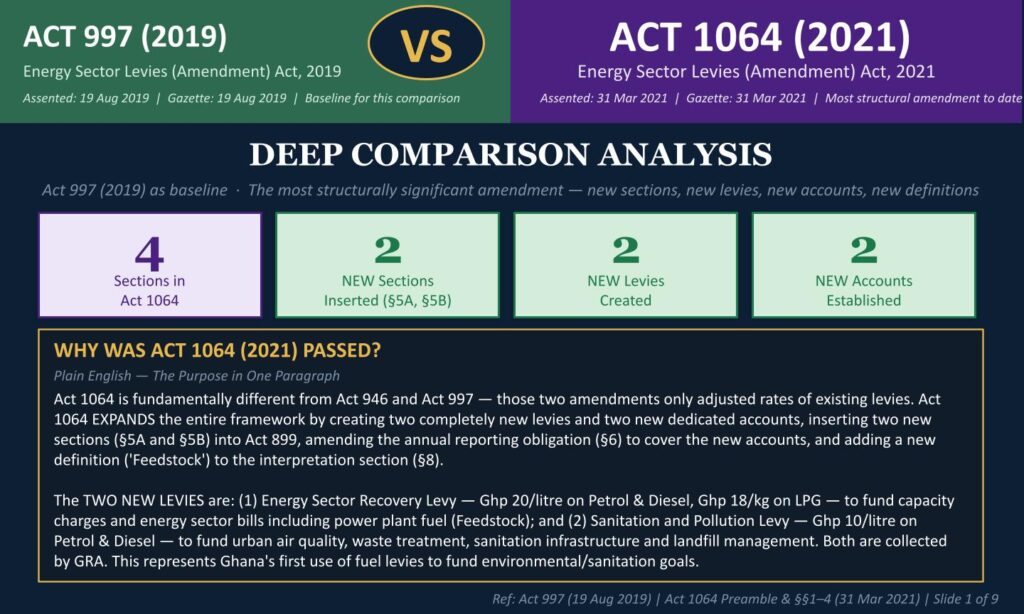
Act 1064 was a different kind of legislation from everything that had come before it. Act 946 and Act 997 had merely adjusted numbers. Act 1064 expanded the entire framework — adding new sections to Act 899, creating new levies, establishing new accounts and even coining a new legal definition.
What was genuinely new:
Parliament inserted Section 5A into Act 899 — an entirely new section creating the Energy Sector Recovery Levy and its dedicated Energy Sector Recovery Account. The levy was charged at GHp20 per litre on petrol and diesel, and GHp18 per kilogramme on LPG. Its purpose: to pay “capacity charges in the energy sector” and “energy sector bills including support for Feedstock.”
Feedstock — now there was a new word in Ghanaian energy law. Parliament simultaneously inserted a new definition into Section 8: “Feedstock means fuel utilised by a power plant to generate or produce energy.” In plain language: the gas and oil that power stations burn to generate electricity. Ghana’s power plants were running up unpaid fuel bills, and Act 1064 created a dedicated levy specifically to pay those bills. The legal definition ensured nobody could argue about what “feedstock” meant.
Parliament also inserted Section 5B — creating the Sanitation and Pollution Levy and the Sanitation and Pollution Account. Charged at GHp10 per litre on petrol and diesel (LPG was excluded — a deliberate policy choice to keep cooking gas affordable for lower-income households), this levy had five specific permitted uses:
- Improving air quality in urban areas and combating pollution
- Designing and constructing waste treatment and disposal facilities, recycling plants and landfill sites
- Building sanitation infrastructure to eliminate open defecation
- Funding disinfestation, disinfection and fumigation of public spaces, schools, lorry parks, health centres and markets
- Maintaining major landfill sites and waste treatment plants
This was unprecedented in Ghana’s energy levy history. For the first time, money from fuel charges was being directed toward environmental and sanitation goals — goals that had nothing to do with electricity generation or road maintenance, but everything to do with the quality of life in Ghanaian cities. The specificity of the five permitted uses was also legally significant: it meant the government could not dip into the Sanitation and Pollution Account for anything other than those five purposes.
Act 1064 also amended Section 6 (the annual reporting obligation) to require the Minister to cover all five accounts in the annual Parliament report — not just the original three. And it adjusted the First Schedule of Act 899, adding two new rows (Rows 7 and 8) for the new levies. The First Schedule now had eight rows.
In plain language: By 2021, Ghana’s energy sector needed more than a rate adjustment. It needed new money for new problems — specifically, unpaid power plant fuel bills and the mounting sanitation crisis in Ghana’s cities. Parliament created two new levies and two new accounts to address these specific needs. After Act 1064, every litre of petrol or diesel you bought carried GHp30 more in levies than it had before (GHp20 for energy recovery and GHp10 for sanitation). It was a significant additional burden, but it was targeted at real, documented problems.
THE BOLD RESET — ACT 1135 (2025) AND THE END OF AN ERA
Ten years. Four Acts. Eight levies. Seven accounts. Multiple sections. Sub-sections. Sub-accounts. Cross-references. Amendments to amendments. The legal framework that had started as a clean consolidation in 2015 had, through entirely legitimate and necessary evolution, become a layered, complex patchwork.
A lawyer advising a client on Ghana’s energy levies in 2024 would need to simultaneously read Act 899 (2015), Act 946 (2017), Act 997 (2019) and Act 1064 (2021) — cross-referencing them constantly, because each amendment changed only parts of the others. It was legally valid. It was administratively challenging.
There was also a deeper problem. The sheer number of accounts — seven, by 2024 — meant that money was being split into smaller and smaller streams, each governed by its own rules, each requiring its own reporting. The Energy Debt Service Account. The Power Generation and Infrastructure Support Sub-Account. The Price Stabilisation and Recovery Account. The Energy Sector Recovery Account. The Sanitation and Pollution Account. The Public Lighting Levy Account at the Bank of Ghana. The National Electrification Fund Account at the Bank of Ghana.
Seven pots. Seven sets of rules. Seven streams of money, all ultimately serving variations of the same broad goal: keeping Ghana’s energy sector financially sustainable.
And then there was the problem of the levies themselves. Were consumers — and even businesses — clear on what they were paying for? A litre of petrol, after all the applicable levies under Act 1064, carried the following petroleum-based charges:
- GHp49 (Energy Debt Recovery)
- GHp16 (Price Stabilisation)
- GHp20 (Energy Sector Recovery)
- GHp10 (Sanitation and Pollution)
- GHp48 (Road Fund)
- GHp1 (Energy Fund)
Six separate charges. Different rates. Different accounts. Different purposes. Different collecting mechanics. Could any ordinary Ghanaian at a filling station tell you what each one was for? Almost certainly not.
Parliament decided it was time to start again.
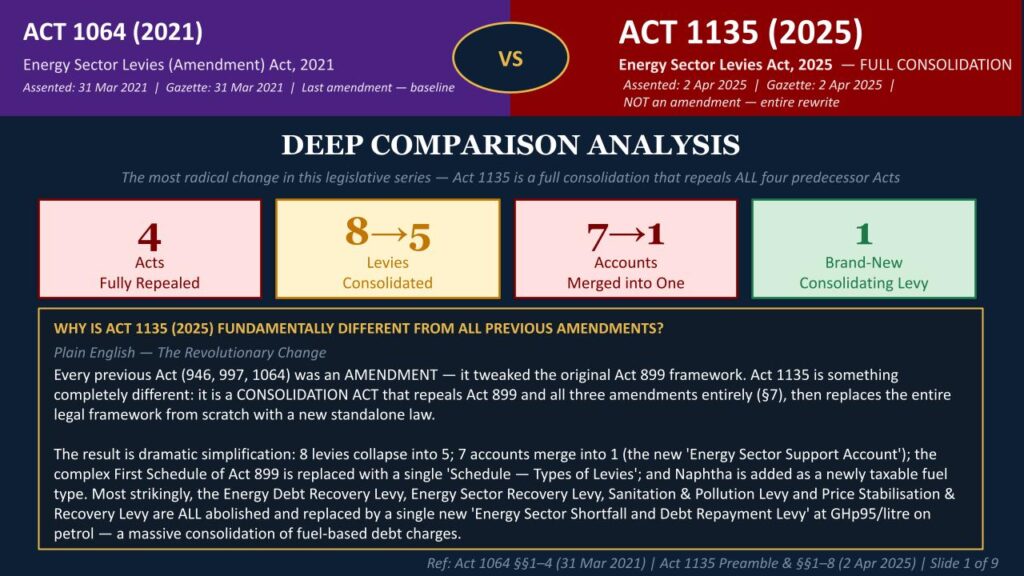
On 2nd April 2025, the President signed Act 1135 — the Energy Sector Levies Act, 2025. It was gazetted the same day. No delay. The urgency was clear.
WHAT ACT 1135 DID: THE MOST CONSEQUENTIAL PROVISION IN TEN YEARS
Act 1135 opened with a preamble that echoed the very first words of Act 899 a decade earlier: “An Act to consolidate existing energy sector levies to promote prudent and efficient utilisation of proceeds generated from the levies to address energy sector shortfall payments, energy sector legacy debts and provide for related matters.”
Parliament was doing in 2025 what it had done in 2015 — consolidating. But this time, the consolidation was more radical. This time, there was a §7.
Section 7 of Act 1135 — the nuclear repeal clause — reads:
“The following enactments are repealed: (a) the Energy Sector Levies Act, 2015 (Act 899); (b) the Energy Sector Levies (Amendment) Act, 2017 (Act 946); (c) the Energy Sector Levies (Amendment) Act, 2019 (Act 997); and (d) the Energy Sector Levies (Amendment) Act, 2021 (Act 1064).”
Four Acts – Cancelled – In one provision.
Act 899, which had itself swept away the old 1995 and 2003 laws. Act 946, which had brought relief to electricity consumers. Act 997, which had asked fuel users to carry more of the burden. Act 1064, which had created Ghana’s first environmental fuel levy. All of them — gone from the statute book.
But the savings clause immediately followed: any rights, liabilities or obligations that existed under those old Acts the moment before repeal would continue to exist until they were exercised or terminated. Nobody’s existing debt or entitlement disappeared overnight. The law changed; the obligations did not.
THE NEW FRAMEWORK: SIMPLICITY AS A POLICY CHOICE
Eight levies became five.
The four complex petroleum-based levies — Energy Debt Recovery, Price Stabilisation and Recovery, Energy Sector Recovery, and Sanitation and Pollution — were abolished as separate charges and merged into a single new levy with a single new name:
The Energy Sector Shortfall and Debt Repayment Levy.
Its rates:
- GHp95 per litre on petrol — which, if you add up the four old levies it replaced (GHp49 + GHp16 + GHp20 + GHp10), equals exactly GHp95. This was consolidation, not a new tax increase.
- GHp93 per litre on diesel — again matching the combined old rates precisely.
- GHp95 per litre on naphtha — an entirely new fuel type being formally taxed for the first time.
- GHp4 per litre on fuel oil and GHp3 per litre on Marine Gas Oil — unchanged from before.
- GHp73 per kilogramme on LPG — consolidating the old LPG components.
The Road Fund Levy stayed at GHp48 per litre — now extended to include naphtha alongside petrol and diesel.
The Energy Fund Levy stayed at GHp1 per litre — also now including naphtha.
The Public Lighting Levy stayed at 3% per kilowatt-hour. But Act 1135 restored something that Act 946 had removed in 2017: the hit-and-run motor vehicles clause — the explicit authorisation to use Public Lighting funds to replace street lights destroyed by reckless drivers. After eight years in legislative limbo, that purpose came back.
The National Electrification Scheme Levy stayed at 2% per kilowatt-hour.
Seven accounts became one.
All five dedicated accounts and two Bank of Ghana accounts were abolished. In their place: a single Energy Sector Support Account, managed by the Minister for Finance. Its purpose: paying energy sector shortfalls and energy sector legacy debts. Clean. Simple. Accountable.
The transitional provision (§8) ensured that all the money sitting in the old accounts — collected under the old Energy Debt Recovery Levy, Energy Sector Recovery Levy, Sanitation and Pollution Levy and Price Stabilisation and Recovery Levy — would be transferred into the new Energy Sector Support Account the moment Act 1135 came into force. Not a pesewa would be lost.
And for the first time in ten years of legislation, a specific deadline was set for the annual report to Parliament: 31st March of the following year. No more vague “annual report” with no timeline. The Minister now had a legal deadline — a quiet but significant accountability improvement that previous Acts had all failed to include.
THE NEW CATEGORY: WHAT KIND OF LAW IS ACT 1135?
Legal scholars and policy practitioners will ask: what exactly is Act 1135?
It is not an amendment — it does not modify an existing law; it replaces the entire framework. It is not a revised edition — those are administrative exercises, not parliamentary Acts with new substantive content. It is not “repealed” — it is the repealing instrument, the active current law.
Act 1135 is a Principal (Consolidating) Act — the same category as Act 899 itself, but arriving at the end of a legislative cycle rather than the beginning. It stands alone. It is self-contained. It has its own structure, its own Schedule, its own definitions, its own regulations power. Any future Parliament that wants to change Ghana’s energy levies will amend Act 1135, not any of its predecessors. Those predecessors are history.
EPILOGUE: WHAT THIS MEANS FOR YOU
The next time you pull into a filling station and the attendant fills your tank, you are participating in a legal structure that has been ten years in the making.
Every GHp95 per litre on your petrol is not a new charge. It is the consolidation of four charges that have been built up since 2015 — each one created to address a specific, documented crisis in Ghana’s energy sector. The TOR debts from the early 2000s. The power utility debts of the mid-2010s. The capacity charges crisis of 2020 and 2021. The sanitation needs of Ghana’s growing cities. All of it, collected one pesewa at a time, at every filling station in the country.
The electricity levy you see on your bill — that 3% for public lighting and 2% for electrification — has been with you since 2015, adjusted downward in 2017 to ease your burden, and kept at those lower rates all the way through to today.
The road you drive on after you leave the filling station — the money to patch and maintain it came from the GHp48 Road Fund Levy that has been embedded in every litre of fuel since 2019.
Conclusion
This is the story of Ghana’s Energy Sector Levies Acts: not a story of hidden taxes or government plunder, but a story of a country working through its energy sector’s inherited problems, one law at a time, with Parliament adjusting course as circumstances changed — cutting rates when the burden was too high, raising them when the need was urgent, adding new tools when new problems emerged, and finally, in 2025, stepping back and saying: let us bring all of this together in one clean law that every Ghanaian can understand.
Ten years. Five Acts. One story. Every pesewa, accounted for.
References
This article is based on a detailed legal analysis of the;
- Energy Sector Levies Act, 2015 (Act 899)
- Energy Sector Levies (Amendment) Act, 2017 (Act 946)
- Energy Sector Levies (Amendment) Act, 2019 (Act 997)
- Energy Sector Levies (Amendment) Act, 2021 (Act 1064)
- Energy Sector Levies Act, 2025 (Act 1135)
all Acts of the Parliament of the Republic of Ghana. All figures cited are sourced directly from the official text of the respective Acts.
